
RV battery not charging: how to troubleshoot the converter and 12V system
When an RV battery won't charge, the fault is usually one of four things: the battery itself, the disconnect switch, the converter's power supply, or a connection in between. A multimeter and 30 minutes will usually tell you which.
Recommended tools & parts for this job
Electrical & testing
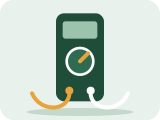
Digital multimeter (auto-ranging, with DC amps)
The single most useful RV diagnostic tool: checks battery voltage, fuses, switches, continuity and 120V outlets.
Check price on Amazon.ca
Batteries, solar & inverters
Shunt-based battery monitor
Shows real state of charge and amps in/out, far more accurate than a voltage-only gauge.
Check price on Amazon.ca
Batteries, solar & inverters
Battery terminal cleaning brush
Cleans corroded posts and clamps, a common cause of charging problems.
Check price on Amazon.ca
Batteries, solar & inverters
Smart multi-stage battery charger / maintainer
Keeps stored batteries healthy over a Calgary winter without overcharging.
Check price on Amazon.ca
Electrical & testing
Dielectric grease
Protects connectors, trailer plugs and bulb sockets from moisture and corrosion.
Check price on Amazon.ca
Electrical & testing
Automotive blade fuse assortment
Keep spares of every size your RV uses.
Check price on Amazon.caAs an Amazon Associate I earn from qualifying purchases. Always confirm part numbers and sizes against your RV or appliance model before ordering. See all recommended RV tools & parts →
How RV 12V charging works
Your RV has a house battery (or bank) that runs lights, the water pump, furnace fan, slide motors, the propane detector and control boards. It gets charged from up to three sources:
- The converter/charger, which turns 120V shore or generator power into 12V DC and charges the battery.
- The tow vehicle or motorhome engine, through the 7-way trailer plug or an isolator.
- Solar, through a charge controller. See RV solar not charging: how to troubleshoot panels, controller and wiring.
If the battery dies even while plugged in, the converter isn't doing its job or the charge isn't reaching the battery.
Safety: Batteries can deliver enough current to weld a wrench to a terminal and cause burns. Remove rings and watches, use insulated tools, and never lay tools across the terminals. Flooded lead-acid batteries vent hydrogen gas while charging. Keep sparks and flames away and work in a ventilated area. Wear eye protection. 120V inside the converter can kill. Don't open the converter case unless you are qualified.
Step 1: Measure the battery
Use a Digital multimeter (auto-ranging, with DC amps) set to DC volts.
- Disconnect shore power and turn off loads, then let the battery rest for an hour or so if you can.
- Measure across the battery terminals.
For a 12V lead-acid battery (flooded, AGM), a rough guide is about 12.6V or slightly higher when fully charged and resting, with roughly 12.2V at about half charge. Readings much below 12V mean it's deeply discharged. For lithium (LiFePO4) batteries, voltage stays fairly flat across most of the charge range, so a shunt-based battery monitor is a far better gauge. Check your battery maker's chart either way.
- Now plug into shore power and measure again after a few minutes. If the converter is charging, the voltage should rise noticeably. Many converters charge somewhere in the 13.2V to 14.4V range, depending on the stage and battery type. If the voltage stays the same as resting, nothing is charging the battery.
Step 2: Check the battery disconnect
Many RVs have a battery disconnect switch near the entry door or battery compartment. On some RVs, "off" disconnects the battery from the converter as well as the loads, so the battery won't charge while the switch is off. Make sure it's on. Some disconnects are solenoid-based and can fail. If you measure voltage on one side but not the other with the switch on, the switch or solenoid is faulty.
Step 3: Check that the converter has 120V
- At the 120V breaker panel, find the breaker for the converter (sometimes labelled "converter" or "charger"). Reset it by switching it fully off, then on.
- Some converters plug into an outlet behind a panel or under a cabinet. Make sure that outlet has power. It may be on a GFCI circuit that has tripped somewhere else in the RV. See RV outlets not working on shore power: GFCI, breakers and pedestal checks.
- Listen. Many converters have a cooling fan that runs at least occasionally. A converter that's completely silent and cold under load may not be getting power or may have failed.
Step 4: Check the DC fuses
Most converters have one or more large reverse-polarity fuses on the front of the unit. They blow if battery cables are ever connected backwards, which is a common mistake after swapping batteries. Pull them and inspect or test them. Replace only with the same rating.
Also check any inline fuse or breaker on the positive battery cable, often a resettable breaker near the battery or on the frame.
Step 5: Clean and check the connections
Corrosion and loose terminals are a leading cause of "dead battery" complaints.
- Disconnect the negative cable first, then the positive.
- Clean posts and clamps with a terminal brush until bright metal shows. A paste of baking soda and water neutralizes acid residue on flooded batteries.
- Reconnect positive first, then negative. Tighten firmly.
- Coat with dielectric grease or terminal protector.
- Follow the cables. Check the ground cable's connection to the frame and any connections at the converter. A voltage drop test helps: measure from the battery post to the converter terminal while charging. More than a few tenths of a volt difference means resistance in that cable or connection.
Step 6: Test the converter output
With the battery disconnected (or measured at the converter's DC output terminals), a working converter should show a DC voltage in its normal output range when it has 120V input. No output with good input usually means a failed converter or charger section. Some converters have a separate, replaceable charger module. Check your model's manual.
Step 7: Is the battery just worn out?
Lead-acid batteries that have been left discharged, especially through a Calgary winter, can sulfate and lose capacity permanently. Signs of a worn-out battery:
- It reaches "full" voltage quickly on the charger but dies within hours.
- Voltage drops sharply under a small load (such as the furnace fan).
- Swollen case, a bad smell, or (for flooded batteries) one cell reading differently on a hydrometer.
Many auto parts stores can load-test a battery. If it fails, replace it with the same type, or upgrade with a compatible charging profile.
Charging from the tow vehicle while driving
The 7-way plug usually has a 12V charge line, but the wire is often thin and the voltage drop is large. Expect it to maintain a battery rather than recharge a deeply discharged one. If there's no charge at all, check the tow vehicle's trailer charge fuse or relay (see the vehicle manual) and the trailer plug pins for corrosion.
Lithium and cold weather
Most LiFePO4 batteries shouldn't be charged below about 0 °C unless they have built-in heating or a battery management system that blocks cold charging. Check your battery's specifications. If you store or camp in the Alberta cold, this matters. A lithium battery that "won't charge" in January may be protecting itself exactly as designed. Also confirm your converter, solar controller and DC-DC charger are set to a lithium profile.
Winter storage
Fully charge the battery before storage, then either remove it and store it somewhere it won't freeze with a smart maintainer, or leave it connected to a maintainer. A discharged lead-acid battery can freeze and crack at temperatures a charged one survives easily. More in How to winterize an RV for a Canadian winter (step by step).
When to call a pro
Call an RV technician if the converter has 120V in but no output, if you smell burning or see scorched wiring, if fuses blow repeatedly, or if you need to work inside the 120V distribution panel.
How-to videos


Videos are made by third-party creators and load from youtube-nocookie.com only when you press play. Models differ, so always follow your own manuals and the safety notes on this page.
Disclaimer: This guide is general information based on common RV designs. Models differ, so check your owner's manual and appliance manuals. Propane, 120V electrical and brake systems can cause serious injury if handled incorrectly. If you are unsure, stop and book a certified RV technician.